 By Marketing Automation Expert
 79% of marketing leads never convert into sales. Not because of bad ads or a weak offer, but because nobody followed up properly. A lead fills out a form, gets one call, doesn’t answer, and ends up booking with the competitor who sent a text two days later. That’s not a sales problem. That’s a systems problem. GoHighLevel’s workflow builder fixes it permanently.
This is not a sales problem. It is a systems problem, and the numbers back it up. According to Salesforce research, 79% of marketing leads never convert into sales, and the most commonly cited reason is not bad advertising or a weak offer. It is an inadequate follow-up after the lead was captured. GoHighLevel’s workflow builder solves this permanently. A properly built lead nurture sequence follows up automatically across SMS, email, and voicemail for days or weeks after a lead first enters your system without a single manual action from your team. This guide shows you exactly how to build one.
Related reading:
- How to Set Up Your GoHighLevel CRM to Never Lose a Lead
- How to Set Up GoHighLevel for Small Businesses
How do you build a GoHighLevel lead nurture sequence?
In GoHighLevel’s Workflow Builder, set a trigger (typically Form Submitted or Contact Created), then build a series of timed actions, such as SMS, email, and voicemail drops spaced across 14 days. Add conditional logic so the sequence pauses if a lead replies or books an appointment. Include personalization by using contact merge fields, separate sequences by lead source, and build a re-engagement branch for leads who do not convert in the primary window. A fully built sequence requires zero manual follow-up from your team.
Why Manual Follow-Up Always Fails at Scale
Before building the sequence, it helps to understand precisely why manual follow-up cannot scale, even if your team is disciplined.
DemandSage data shows there is a 9-times higher chance of converting a lead if you follow up within 5 minutes of their enquiry. The reality is that most businesses never get close to that. Nearly half of sales reps say they simply do not have time to follow up that fast, and over 40% of businesses admit they have no structured nurturing process at all.
The gap between knowing follow-up matters and actually doing it consistently is exactly what a GoHighLevel lead nurture sequence closes. A basic email autoresponder does one thing. GoHighLevel does everything, SMS, email, voicemail drops, internal notifications, and pipeline updates, all inside one connected workflow. Every lead gets a consistent experience whether your team is available or not.
Further reading: Lead Generation — Wikipedia | Marketing Automation — Wikipedia
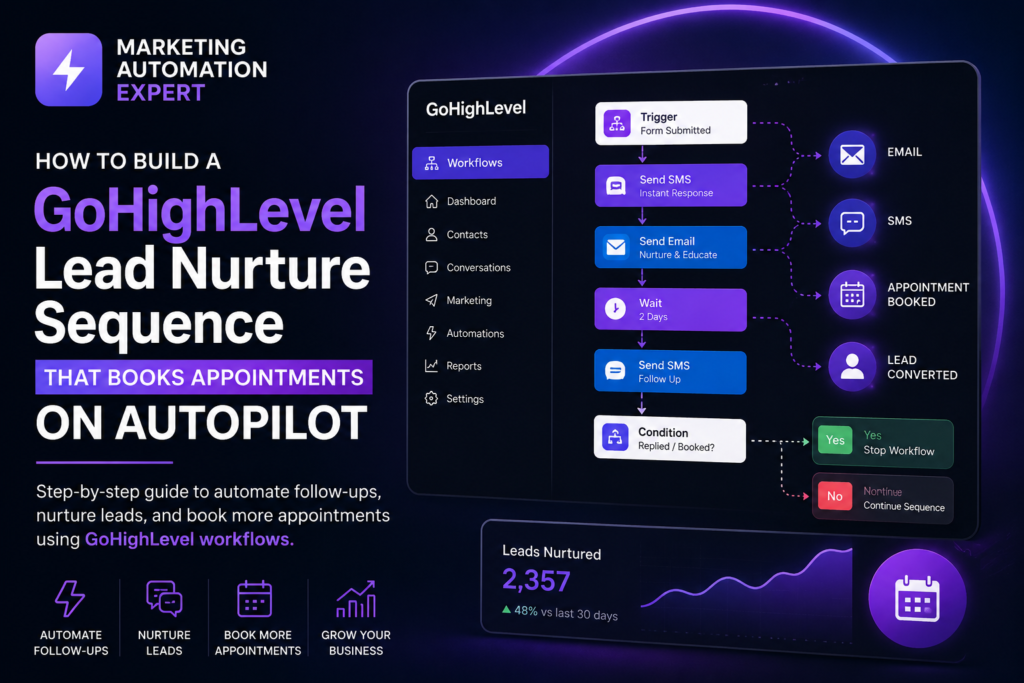
Step 1: Choose Your Trigger Correctly
Go to: Automation – Workflows – Create Workflow
Every nurture sequence starts with a trigger,r the event that fires the workflow. The most common mistake here is using a single generic trigger for every lead source.
Before building workflows, make sure your CRM has defined pipeline stages, tags, and custom fields in place. A clean CRM structure is what allows GHL to trigger the right action at the right moment as leads move through your funnel.
Use separate triggers for separate lead sources:
- Form Submitted for website contact form leads
- Contact Tag Added for Facebook Lead Ad leads (tag applied on import)
- Missed Call for inbound phone enquiries
- Pipeline Stage Changed for leads moved manually by a team member
A Facebook lead, a Google lead, and a referral lead are at completely different stages of awareness. Sending the same opening message to all three is a wasted opportunity. Each source deserves its own first message one that acknowledges where they came from and what they expressed interest in.
Step 2: Build Your 14-Day Sequence Structure
The 14-day window is not arbitrary. Most sales require at least five touchpoints before a prospect is ready to make a decision, and manual follow-up rarely reaches five touchpoints consistently, no matter how organized your team is.
Here is the proven 14-day sequence structure we built for service business clients:
| Day | Channel | Message Type |
| Day 0 (immediate) | SMS | Instant personalized response within 60 seconds |
| Day 1 (4 hours later) | SMS | Friendly check-in, did they receive the info? |
| Day 2 | Case study or client result relevant to their enquiry | |
| Day 3 | SMS | Soft question: “Do you have any questions I can answer?” |
| Day 5 | Educational value a useful tip related to their problem | |
| Day 7 | SMS | Re-engagement: “We still have availability this week” |
| Day 10 | Specific service highlight or outcome example | |
| Day 14 | SMS + Email | Final follow-up direct booking link, low pressure |
Every touchpoint should feel like a natural conversation, not a sales pitch. The goal across the 14 days is to build enough trust and familiarity that the prospect actually wants to boo,k not to pressure them into it. Personalization matters more than frequency. Generic messages get ignored. Use GHL’s merge fields to pull the contact’s first name, service interest, and lead source into every message dynamically, a small change that makes every touchpoint feel like it was written for them specifically.
Step 3: Add Conditional Logic (This Is What Separates a Good Sequence from a Great One)
A nurture sequence without conditional logic is a broadcast. With conditional logic, it becomes a conversation.
Go to: Workflow – Add Action – If/Else
Add these conditions at a minimum:
Condition 1 Lead replied to SMS or email. If the contact replies at any point, the sequence pauses automatically, and the lead is flagged for personal follow-up. Nothing kills trust faster than receiving a generic Day 5 message after you have already had a conversation with the business.
Condition 2 Lead booked an appointment. If the contact books via your calendar link, they exit the nurture sequence entirely and enter your appointment booking confirmation workflow. Sending follow-up messages to someone who has already booked is a fast way to lose their trust.
Condition 3 Lead clicked but did not b. ook If the contact clicked your booking link but did not complete the booking, trigger a specific follow-up: “We noticed you started booking — here’s the link again if you need it.” This single condition recovers a surprising number of nearly-lost appointments.
Condition 4 Lead opened emails but never replied.d Move these contacts to a slower, lower-frequency sequence. They are interested,d just not ready yet. A monthly touchpoint keeps you visible without becoming intrusive.
Step 4: Build the Re-Engagement Branch
Not every lead converts within 14 days,s and that does not mean they are lost. Some are busy. Some are researching and not ready to act yet. After day 14, the workflow checks whether the contact has replied or booked. Those who have not taken any action move into a re-engagement branch, a separate sequence with a completely different tone and angle from the primary one.
Ready to Automate Your Business?
Book a free 30-minute strategy call. We'll audit your GHL setup and build a custom roadmap — completely free.
Get Your Free Audit →A re-engagement branch for days 15–30 might look like:
- Day 17: SMS different angle entirely (“Still thinking about [service]? We worked with a [industry] business last month who had the same question. Here’s what they found…”)
- Day 21: Email a new piece of social proof or a seasonal offer
- Day 30: Final SMS, honest and direct: “I want to make sure we did not miss each other. If the timing is not right, no problem at all, I’ll check back in a few months.”
Leads who still do not respond after day 30 are tagged as Cold Leads in the CRM and moved to a long-term monthly touchpoint list. They are not deleted. Business conditions change; a cold lead today is often a booked appointment six months from now.
Step 5: Connect the Sequence to Your Pipeline and CRM
A nurture sequence that runs in isolation from your CRM is only doing half the job. Every meaningful action in the sequence should update the contact’s pipeline stage and tags automatically.
Go to: Workflow – Add Action – Add to Opportunity / Move Opportunity Stage
Here is how your pipeline should reflect the sequence:
- Lead enters sequence: Pipeline stage: New Lead
- Lead replies: Pipeline stage: Contacted; tag: Replied-[Date]
- Lead clicks booking link: Pipeline stage: Booking Intent; tag: Clicked-Booking-Link
- Lead books: Pipeline stage: Booked; exit nurture; enter confirmation workflow
- Lead completes 14 days with no action: Pipeline stage: Cold; enter re-engagement branch
This means your CRM dashboard reflects your nurture sequence’s real-time status without anyone manually updating a single record. For a deeper look at how pipeline stages and tags connect to your CRM structure, see our GoHighLevel CRM setup guide.
Step 6: Test Before You Publish
Never publish a live nurture sequence without testing it end-to-end on yourself first.
Submit your own contact form using a personal phone number and email address. Confirm:
- The Day 0 SMS arrives within 60 seconds
- The email lands in your inbox, not spam
- Your first name is populated correctly in the message
- Replying to the SMS pauses the sequence correctly
- The pipeline stage updates as expected
The most common mistake we see is building complex multi-branch workflows before the basics are even working. Start with a simple 14-day sequence, test it end-to-end, confirm everything fires correctly, then layer in sophistication. Every workflow should also check whether the lead is already in another active sequence, and add a condition at the start: “if tag X exists, do not trigger.” This prevents the same lead from receiving duplicate messages from two overlapping workflows.
A broken nurture sequence does not just fail to convert; it actively damages your lead relationships with incorrect messages and duplicate follow-ups. Test everything before a single real lead touches it. See the full pre-launch checklist in our GoHighLevel Setup Checklist.
What a Fully Built Nurture Sequence Looks Like in Practice
Here is the full flow from lead entry to booked appointment:
- Lead submits a website form at 8 PM on a Thursday
- Day 0: Instant SMS arrives within 60 seconds, personalized with their name and service
- Day 1: Follow-up SM, S, they read it but do not reply
- Day 2: Email with a client case study they open it
- Day 3: SMS with a soft question, they reply asking about pricing
- Conditional logic fires sequence pauses, lead is flagged for personal follow-up, pipeline moves to Contacted
- Team member calls, answers the pricing question, and sends a booking link
- Lead books enter the appointment confirmation workflow
- Confirmation SMS and email arrive instantly
- Reminders fire at 48 hours, 24 hours, and 2 hours before the appointment
Businesses that deploy this type of system consistently report more booked calls from the immediate Day 0 response alone, which would otherwise have gone cold after 24–48 hours of silence.
The entire journey from cold lead to booked appointment is handled with one personal conversation from your team, and everything else runs on autopilot.
Frequently Asked Questions
How long should a GoHighLevel lead nurture sequence be?
For most service businesses, 14 days covers the majority of leads who will convert in the short term. After that, message frequency should drop not continue at the same rate. Add a 15–30 day re-engagement branch for leads who have not responded, and a monthly long-term touchpoint list for cold leads who simply were not ready yet.
How many touchpoints should I include?
A minimum of 8, a maximum of 14 for the primary sequence. Around half of all leads are qualified but simply not ready to buy at the point of first contact, which is exactly why repeated, structured follow-up matters more than a single well-written first message. Eight touchpoints build enough familiarity without crossing into spam territory.
Should I use SMS or email in my nurture sequence?
Both, but for different purposes. SMS works best for time-sensitive messages, direct follow-ups, and booking CTAs because open rates are significantly higher. Email is better for longer content like case studies, service explanations, and social proof. Alternate between the two based on what each message needs to do, not a fixed schedule.
What happens if someone books mid-sequence?
They exit the nurture sequence immediately and enter your appointment confirmation workflow. GoHighLevel’s conditional logic handles this automatically no manual intervention needed. This is why building the booking condition into your workflow on day one is non-negotiable. Without it, a booked lead will keep receiving follow-up messages, which damages trust fast.
Join Hundreds of Businesses Running on Autopilot
From lead capture to follow-up — we build the full GHL system so you can focus on delivering results, not chasing them.
See How It Works →How do I know if my nurture sequence is working?
Track three metrics inside GHL: reply rate (how many leads respond), booking rate (how many convert to appointments), and sequence completion rate (how many reach Day 14 without booking). A high completion rate with a low booking rate means your messages need rewriting, not your sequence length.
What are the main components of a successful lead nurturing strategy?
A successful strategy has five components: a fast initial response, a multi-touch follow-up sequence across SMS and email, personalized messaging based on lead source and interest, conditional logic that adapts to lead behaviour, and a re-engagement branch for cold leads. Learn how we build all five inside GoHighLevel Lead Nurturing Systems →
How to automate GoHighLevel?
Automation in GoHighLevel is built inside the Workflow Builder. Set a trigger such as Form Submitted or Contact Created then add timed actions like SMS, email, tagging, and pipeline stage updates. For a full walkthrough, read our GoHighLevel Setup Guide →
What is the primary purpose of lead nurturing in marketing automation?
The primary purpose is to stay in consistent contact with prospects who are not yet ready to buy, building trust over time so that when they are ready, your business is the obvious first choice. Without structured nurturing, most leads go cold and convert with a competitor who followed up more consistently.
What is a nurturing lead?
A nurturing lead is a prospect who has shown interest in your business but has not yet made a purchasing decision. They are qualified but not ready. In GoHighLevel, these leads are enrolled in automated sequences that follow up, educate, and build trust on your behalf until they are ready to book.
Ready to Build a Nurture Sequence That Books for You?
A properly built GoHighLevel lead nurture sequence turns the leads you are already generating into booked appointments without your team chasing anyone manually.
At AutomateFlow, we build complete multi-touch nurture systems for service businesses across every industry. Every sequence includes trigger setup, personalization, conditional logic, pipeline integration, and a full pre-launch test delivered in 5–7 business days.
Book your free GoHighLevel audit, no cost, no commitment.
